:focal(2623x1698:2624x1699)?img=iwk_samples_compounding_1_-tide_ocean_material.jpg)
100% recycled ocean-bound plastic
#tide® is a recycled material made from 100% ocean-bound plastic that comes in the form of plastic pellets. These are used by manufacturers for plastic parts as well as for yarns for textiles and fabrics. The recycled plastic material is certified as ocean-bound plastic and can replace virgin plastic in a wide range of applications while meeting demanding quality requirements.
How? In partnership with Professor Daniel Schwendemann and his team at the Swiss University of Applied Sciences, #tide has developed a science-based mechanical plastic recycling process to regenerate the molecular chains of ocean-bound plastic.
Transformation into safe recycled products
#tide® knows how to bring plastic waste back to life, transforming single-use plastics into a high-quality, award-winning material for safe and durable goods.
By using recycled ocean-bound plastic from #tide®, brands and manufacturers give new value to plastic waste that is at risk of polluting the environment and entering the ocean. Replacing virgin plastic with recycled material reduces the need for new fossil resources and can lower the environmental footprint of a product. #tide® brings plastic made from fossil resources back into the material cycle – turning waste into a valuable resource again.
And, of course, brands also benefit from the excellent properties of plastics (e.g. density, moldability, durability, light weight, resilience) that can be influenced by the manufacturing process.
?img=tideoceanmaterial_granules_pet_2-kopie.JPG)
?img=tideoceanmaterial_yarn_2-kopie.JPG)
Our process
:focal(846x650:847x651)?img=tide-ocean-material_thailand_collecting-ocean-bound-plastic-waste.jpg)
Step 1
Collecting Plastic
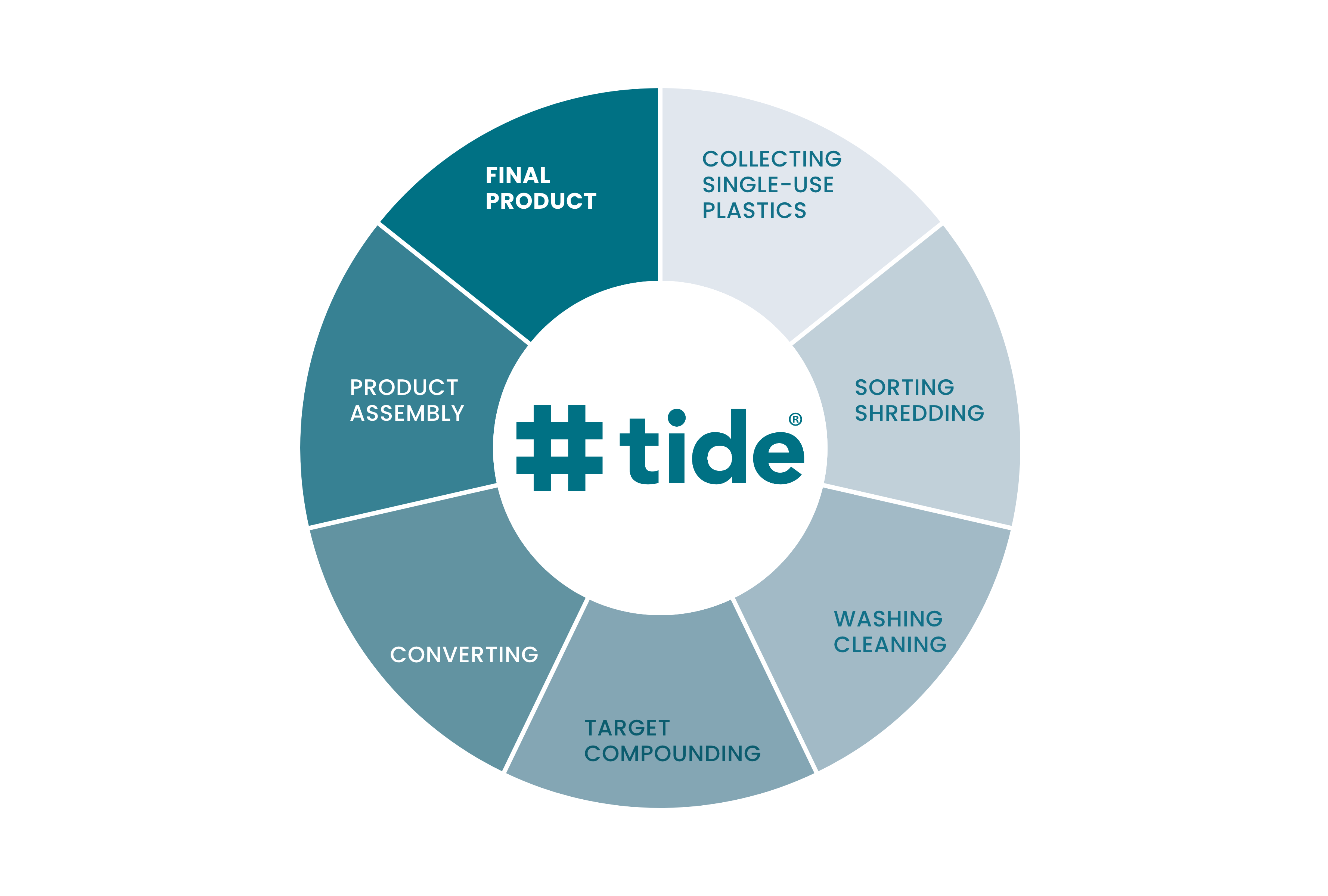
The ocean-bound plastics are collected along coastlines, on islands and beaches, in communities and from landfills. We aim to collect the plastic waste before it can enter waterways and the ocean – preventing plastic pollution at its source. We pay fair wages to members of local coastal communities who collect the plastic waste.
?img=ranong-recycle_team-member-portrait_thailand_-tide-ocean-material.jpg)
Step 2
Sorting
The material is sorted in social enterprises, offering job opportunities to local communities: a plastic bottle can consist of several types of plastic, for example PET (bottle), PP (screw cap) and PET-G (label). The local teams ensure that these plastics are separated, cleaned and pressed into bales for further processing. We collect PET, PP, HDPE, LDPE and PA6.
?img=csvisuala_20201021_iwk0058-2_alex_ramsauer_daniel_schwendemann_iwk_rapperswil.jpg)
Step 3
Quality Control
The processing and recycling of plastic waste is overseen by #tide®’s in-house Research and Development department. For quality control, #tide® also works with external partners, including laboratories and testing institutes such as SGS and TÜV SÜD. In addition, #tide® benefits from its partnership with the Institute for Materials Technology and Plastics Processing (IWK). Specialized in plastics processing, the institute supports #tide® in its development work with its expertise, laboratories and testing capabilities.
#tide® transforms brittle plastic waste into a high-quality second-life raw material with a remarkable degree of purity – without adding any virgin plastic.
?img=upcycling-ocean-bound-plastic-tide-ocean-material.jpg)
Step 4
Targeted Compounding
Our raw material is 100% recycled ocean-bound plastic. Depending on the final product, our experts know how to match the properties of the collected and recycled ocean-bound plastic waste to the manufacturing process. Different applications have different material requirements – our targeted compounding allows us to match these requirements while maintaining consistent material quality.
:focal(2020x3217:2021x3218)?img=csvisuala_20201021_iwk0054-2.jpg)
Step 5
Manufacturing
#tide® is an industry-ready material that comes in form of pellets. These granules are suitable for a wide range of plastic and textile applications. They can be further processed into recycled plastic filaments, recycled polyester yarns and recycled fabrics. Our Global Grades provide defined and consistent material properties across batches, giving manufacturers reliable quality for their production processes. Our scientists and partners are constantly researching new applications and processes, from film extrusion to blow moulding.
:focal(1600x1681:1601x1682)?img=tideoceanmaterial_granules_pet_6.JPG)
?img=grs_rcs_website_cu.png)
?img=obp-logo_certifications_-tide-ocean-material.jpg)
?img=reach-logo-compliant-with-tide-ocean-material2.jpg)
?img=rohs-logo-compliant-with-tide-ocean-material.jpg)
?img=swiss-plastics-award_2020_tide-ocean-sa.jpg)
?img=prix-strategis_2024_tide-ocean-sa.jpg)
?img=hk_international-business-award.jpg)
?img=swiss-ethics-award-2022.jpg)
?img=swiss-plastics-award_2023_-tide-ocean-material.png)
?img=tide-ocean-material_swiss-packaging-award.png)
:focal(2118x1662:2119x1663)?img=tideoceanmaterial_materialica_design_technology_award_012.jpg)
?img=tide-ocean-sa_autobahn-startup_sustainability-award_plug-play_.jpg)
Professional project support
#tide® not only supplies recycled ocean-bound plastic, but also offers professional project support along the entire value chain: from the initial idea and raw material selection to process engineering support and the final application.
CClients benefit from #tide's control over the whole supply chain and our innovative approach of a targeted recycling: #tide® helps assess the feasibility of a final product at an early stage. Our specialists understand the technical properties of our materials, provide Technical Data Sheets and share their expertise on the application of recycled ocean-bound plastics: #tide's internal technologists and external research partners support the development and testing of new material properties.
Thanks to our collaboration with scientific partners from the Institute for Materials Technology and Plastics Processing, we have access to specialized research facilities for component design and production in plastics technology including their wide range of technical facilities:
Injection moulding machines
Extrusion lines
Weathering equipment
DSC measuring device
Residual moisture device
MFI/MVR measuring device
Light booths
Spectrophotometer for colour and material analysis and archiving
The team at the IWK also works with a state-of-the-art technical infrastructure, allowing us to simulate specific customer requirements:
Flat film line
Blown film line
Rolling mill and press
Bottle blowing machine
Injection moulding machine
Pipe extrusion line
?img=plastic-collection_team-member-portrait_12_-tide.jpg)
Traceability
Transparency is key
Transparency has been at the core of our business model since day one. We believe it is essential for building trust. That is why we are committed to providing clear and traceable information about the origin and processing of our recycled ocean-bound plastic.